
To sell an inherited house, the beneficiary or executor must first ensure ownership is legally transferred, either through the probate process if inherited without a will or by directly transferring the title with a valid will. After confirming ownership, they must establish the fair market value through a death appraisal or comparative market analysis (CMA) and report any taxable events, such as long-term capital gains from the stepped-up basis, using IRS Form 8949 and Schedule D (Form 1040).
The executor or financial advisor then manages outstanding debts, closing costs, and distributes estate assets before moving forward with the sale. It is important to address tax return implications and ensure all required documentation is ready before listing. Once these steps are completed, the sale can proceed smoothly, minimizing delays.
Selling an inherited house requires careful attention to legal steps, tax considerations, and the selection of the right selling method. Consulting professionals, such as attorneys, tax advisors, and real estate agents, ensure a smooth transaction. The next logical steps are reviewing necessary documents, understanding financial obligations, and choosing the best approach to selling.

What Are the Things to Know Before Selling an Inherited House?
Before selling an inherited house, the executor or trustee must ensure ownership is legally transferred, conduct a property inspection, determine the fair market value, and evaluate any tax implications, including capital gains tax. The executor must also confirm whether the property was inherited as joint tenants or through survivorship and manage any family dynamics if multiple heirs are involved. Additionally, any outstanding debts or closing costs should be settled before proceeding with the sale.
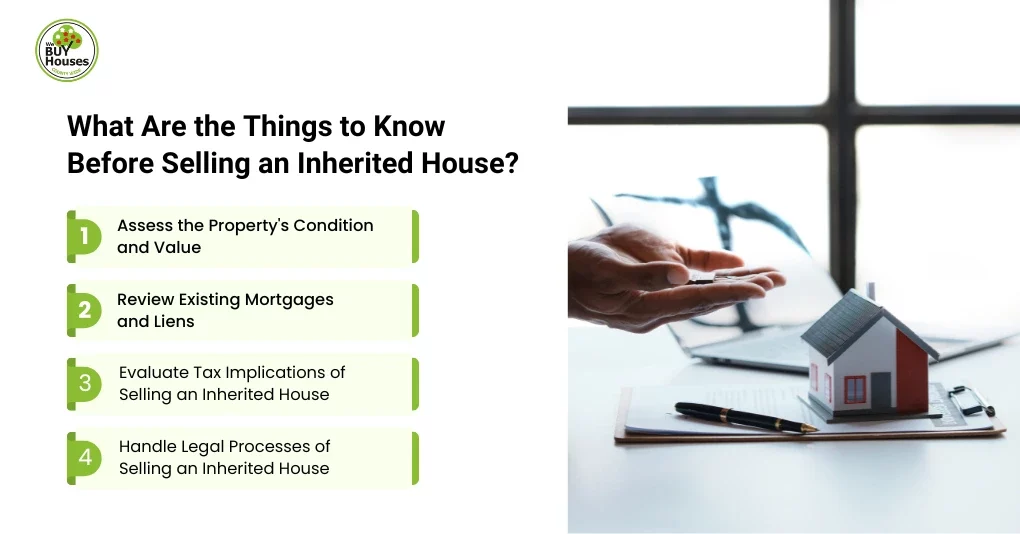
Assess the Property’s Condition and Value
To assess an inherited house’s condition and value, begin by scheduling a property inspection to identify any necessary repairs or improvements. This will help beneficiaries determine whether the property should be sold as-is or if investing in repairs will increase its marketability. Next, a local appraiser or comparative market analysis (CMA) will establish the fair market value, which is crucial for pricing the property accurately. Understanding the property’s value and condition will guide decisions on whether to make repairs or sell the house quickly in its current state.
Review Existing Mortgages and Liens
Executors and beneficiaries should start by reviewing any existing mortgages or liens on the inherited property, as these can affect the sale process. Common liens include unpaid property taxes, home equity loans, or mechanics’ liens. To identify these financial obligations, the executor should obtain a title report. Clearing any outstanding debts is essential before the sale can proceed smoothly. Working with a real estate attorney or financial advisor can help ensure these issues are resolved efficiently, preventing delays and ensuring the sale moves forward without complications.
Evaluate Tax Implications of Selling an Inherited House
Selling an inherited house involves tax considerations, primarily capital gains tax and estate tax. However, the stepped-up basis adjusts the property’s value to its market worth at the time of inheritance, potentially reducing taxable gains. Working with a tax professional ensures that all tax obligations are managed properly, preventing unexpected financial issues and allowing the sale to move forward smoothly.
- Capital Gains Tax
When selling an inherited property, capital gains tax may apply on the profit made from the sale. The property benefits from a stepped-up basis, meaning its value is adjusted to the current market price at the time of inheritance, potentially lowering the taxable amount.
- Estate Taxes
Estate taxes are assessed on the total value of the deceased’s estate, and if it exceeds the exemption limit, the estate must pay these taxes before distribution. It is essential to understand these limits as they can impact the inheritance received by the beneficiaries.
- Inheritance Tax
Depending on the state, inheritance tax may be applied to the value of the property passed on to the heir. Unlike estate taxes, this tax is paid by the beneficiary and varies based on the heir’s relationship to the deceased.
- Property Taxes
After inheritance, property taxes may be reassessed based on the property’s current market value. It is important to check with local authorities to determine if there are any changes in the tax assessment that could affect the sale process.
- Closing Costs and Transaction Fees
In addition to taxes, there are closing costs and transaction fees associated with the sale, such as agent commissions, title insurance, and other administrative costs. These fees can add up, so it is important to factor them into your financial calculations when planning the sale.
Handle Legal Processes of Selling an Inherited House
Selling an inherited house involves navigating several legal processes, including the probate process, settling any debts and liabilities, and ensuring the legal title is transferred. The executor or trustee must address these legal steps before the property can be sold, which may involve consulting with legal and financial professionals to ensure compliance. Here is what needs to be done:
- Navigate the Probate Process
If the property is inherited without a will, the estate must go through the probate process. This legal procedure validates the will (if there is one) and allows the executor to manage the estate’s distribution, including the sale of the house.
- Differentiate Between Trusts and Wills
A will requires the property to go through the probate process, which can delay the transfer of ownership. In contrast, a trust allows the property to be transferred directly to the heirs without the need for probate, simplifying the process and potentially speeding up the sale.
- Settle Debts and Liabilities
Before selling the house, the executor must ensure all debts and liabilities tied to the property are settled. This can include paying off mortgages, property taxes, and any outstanding liens, which need to be cleared before the property can be legally transferred.
- Transfer the Legal Title
The legal title of the property must be transferred from the deceased’s name to the heir’s name before a sale can proceed. This process often involves filing paperwork with local authorities, and in some cases, a probate court order may be required.
- Prepare the Deed for Sale
Once the title has been transferred, the deed for the property must be prepared. This legal document formalizes the transfer of ownership and must be signed by the executor or trustee before the sale is finalized.
How Do You Sell an Inherited House with Multiple Heirs?
Selling an inherited house with multiple heirs requires the heirs to reach consensus on key decisions such as the selling method, division of proceeds, and handling any debts or liabilities tied to the property. The executor or trustee must facilitate communication to ensure agreement between all heirs. If disagreements arise, options like a partition action or buyout may be necessary to proceed, with clear documentation to prevent delays.
Reach Consensus Among Heirs
When multiple heirs are involved in selling an inherited property, it is crucial to reach consensus on decisions like whether to sell, how to divide the proceeds, and who will manage the sale. The executor or trustee helps facilitate these discussions, ensuring all heirs’ interests are considered. Addressing concerns early, such as who will handle repairs and listing, prevents delays and ensures a smooth process. Clear communication and transparency are essential to ensure that all parties are on the same page and the sale can proceed without issues.
Initiate a Partition Action or Explore Buyout Options
If heirs cannot agree on selling the property, a partition action may be needed, where the court either divides the property among the heirs or orders its sale and distributes the proceeds. Alternatively, heirs may explore a buyout option, where one or more heirs purchase the shares of others to gain full ownership of the property. A buyout can be a faster, more amicable solution, but it requires agreement on the property’s value and compensation.
Document the Agreement Between Heirs
Once all heirs have reached an agreement on how to handle the sale or distribution of the inherited property, it is important to document the agreement in writing. This ensures clarity and prevents potential conflicts in the future. The executor or trustee should work with a legal professional to draft a formal agreement that outlines the terms, including how the proceeds will be divided, who is responsible for any debts, and any actions required from each heir. Having a signed, legally binding document protects all parties involved.
Appraise the Property for Fair Distribution
To ensure fair distribution among heirs, the inherited property should be appraised to determine its fair market value. This appraisal helps establish each heir’s share and ensures an equitable division of proceeds. The executor should hire a local appraiser to assess the property’s value, taking into account the current market conditions and any needed repairs. Having an official appraisal prevents disputes by providing a clear, objective basis for the property’s value.
How Do You Sell an Inherited House as a Sole Owner?
Selling an inherited house as a sole owner requires transferring ownership, completing the necessary legal steps, preparing the property, choosing a selling method, and paying any taxes or outstanding expenses. With full decision-making authority, you can move through these tasks more efficiently, but you must still update the title, ensure the property is ready for market, and settle financial obligations before listing. Once these steps are handled, the sale can proceed smoothly.
Transfer Ownership and Address Legal Considerations
To sell an inherited house as a sole owner, you must first ensure the legal title is transferred into your name by providing the death certificate, will or trust documents, and any required probate filings. If the property was not part of a valid will or trust, the probate process must confirm your ownership before you can proceed. Once the title is updated, review any remaining legal obligations, such as unresolved claims, documentation requirements, or needed disclosures, to ensure the property is fully compliant and ready for sale.
Maintain the Property and Prepare It for Sale
To prepare an inherited house for sale, handle basic maintenance such as repairs, cleaning, and safety fixes. A pre-listing home inspection can help you decide whether to make improvements or sell the house as-is. Simple improvements, like fresh paint, landscaping, and decluttering, can increase the home’s appeal and potential resale value. Ensuring the property is well-maintained helps attract qualified buyers and supports a smoother selling process.
Choose Your Selling Method
As a sole owner, you must choose a selling method that fits your timeline, financial goals, and the property’s condition. Listing with a realtor offers MLS exposure and a wider buyer reach, while selling to a cash buyer provides a faster, as-is sale with fewer contingencies. Auctions or off-market options can also work if you prefer a simplified process without traditional listing requirements. Understanding how each option affects pricing, time-to-close, and required preparation helps you select the best approach.
Pay Necessary Taxes and Other Expenses
Before selling an inherited house as a sole owner, you must account for taxes and expenses tied to the property. This includes potential capital gains tax, property taxes, and any remaining estate-related obligations. You may also need to cover closing costs, such as title fees, escrow charges, or minor repairs required for the sale. Reviewing these expenses with a tax professional or financial advisor ensures you understand your obligations and avoid unexpected costs at closing.
Should You Renovate or Sell an Inherited House As-Is?
Deciding whether to renovate an inherited house or sell it as-is depends on the property’s condition, your timeline, budget, and the home’s potential resale value. Renovating can attract more qualified buyers and increase market competitiveness, while selling as-is offers speed and eliminates the need to manage repairs or upfront costs. Comparing repair expenses with projected returns helps determine which option provides the stronger financial outcome.
When Repairs Increase Sale Value
Repairs increase an inherited home’s sale value when they address issues that most buyers view as high-risk or high-cost. Major improvements, such as replacing a failing roof, updating an aging HVAC system, or correcting electrical or plumbing deficiencies, can significantly boost buyer confidence and reduce inspection objections.
Cosmetic upgrades, such as new flooring, interior paint, modern light fixtures, and landscaping, can enhance the home’s curb appeal and help it compete with renovated listings. For example, investing $6,000 in a roof replacement or $3,500 in updated flooring can raise the resale price by $12,000–$20,000, depending on the local market. A pre-listing home inspection helps identify which improvements yield the highest return, allowing you to prioritize repairs strategically.
When Selling As-Is Makes More Sense
Selling an inherited house as-is makes sense when repair costs outweigh the likely increase in resale value or when a faster, low-effort sale is needed. Homes with major issues such as foundation problems, outdated electrical systems, or roof damage can require $20,000 to $60,000 in repairs without guaranteeing a strong return.
Sellers with limited time, funds, or capacity to manage renovations may also benefit from selling the house as-is. Estate timelines, out-of-state ownership, limited resources, or emotional stress can make renovations difficult to manage. For example, a home needing $40,000 in structural and electrical repairs may only gain $20,000 in added value, making the investment impractical. In these situations, selling as-is to a traditional buyer or a cash buyer can provide a quicker, more predictable closing.
Cost-Benefit Analysis for Inherited Properties
A cost-benefit analysis helps determine whether it is financially smarter to renovate an inherited property or sell it as-is. Start by estimating repair costs, including labor, materials, and the time required. Also factor in carrying costs such as property taxes, insurance, and utilities during the renovation period.
Next, compare these costs with the potential increase in resale value after repairs. A local appraiser or real estate agent can help estimate the property’s value in its current condition versus its improved condition. This comparison shows whether renovations will produce a meaningful return.
For instance, investing $15,000 in cosmetic upgrades might increase the sale price by $25,000, making the improvements worthwhile. However, an $80,000 structural repair that adds only $45,000 in value suggests selling as-is is the more practical choice. Reviewing these numbers objectively ensures your final decision aligns with your financial goals and timeline.
How Do You Choose the Right Selling Method for an Inherited House?
Choosing the right selling method for an inherited house means comparing options like listing with a realtor, selling to a cash buyer, using an auction, or selling off-market. Your timeline, the home’s condition, and your financial goals determine which approach works best. Understanding how each method affects price, speed, and required effort helps you choose the most suitable path.
Selling with a Realtor
Selling an inherited house with a realtor provides professional support for pricing, marketing, and managing the transaction. A real estate agent lists the home on the MLS, coordinates showings, negotiates with buyers, and handles contingencies, helping increase exposure and attract stronger offers.
Realtor commissions, typically 5 to 6% of the sale price, increase overall closing costs, which is why some sellers choose to avoid an agent to save money. However, selling a house without a realtor often reduces market exposure, limits buyer reach, and shifts all paperwork and negotiations onto the seller. Working with a realtor is ideal when maximizing sale price and ensuring a smooth, guided process is the priority.
Selling to Cash Buyers
Selling an inherited house to a cash buyer offers a fast, simplified process with no need for repairs, staging, or financing approvals. Many cash buyers purchase homes as-is and can close in as little as 7 to 14 days, making this option ideal when the property has significant damage, outdated systems, or personal belongings that would delay a traditional sale.
Although cash offers are typically lower than full market value, the reduced contingencies, quicker closing timeline, and minimal prep work appeal to sellers who need speed or want to avoid renovation costs. This approach is especially useful when navigating time-sensitive estate obligations or limited resources.
Selling through Auction
Selling an inherited house through an auction can be effective when you want a fast sale, need a set sale date, or have a property that is hard to price due to its condition or location. Auctions often draw competitive bidders that can drive the price up, and a home valued at $350,000 might sell for $380,000 if multiple buyers participate aggressively. However, the outcome is not guaranteed, and some properties may sell for less than market value if demand is low. Auction fees and marketing costs also reduce net proceeds, making this method best for sellers who prioritize speed and certainty over maximizing price.
Selling FSBO (For Sale By Owner)
Selling an inherited house FSBO requires you to manage all parts of the sale yourself, including pricing, marketing, scheduling showings, preparing disclosures, and completing contracts. This method allows you to avoid the typical 5 to 6% realtor commission and maintain full control over the process. However, comparing FSBO with using a realtor, FSBO limits your marketing reach because the property does not appear on the MLS, and you miss out on professional pricing guidance and negotiation support.
As a result, FSBO homes often attract fewer buyers and may sell for less than agent-listed properties, which can offset the commission savings. FSBO is most effective when the property is easy to market, and you have the time and experience to manage the transaction confidently.
What Are the Alternatives to Selling an Inherited Property?
Alternatives to selling an inherited property include renting it for income, donating it for potential tax benefits, or keeping it for personal or family use. Renting can generate steady revenue but requires ongoing maintenance, while donating may create a charitable deduction. Keeping the property provides long-term value but comes with continued costs.
Renting the Property
Renting an inherited property can generate steady rental income, making it a strong alternative if you want long-term financial returns instead of an immediate sale. For example, a home that rents for $2,400 per month can generate $28,800 per year before expenses. However, becoming a landlord requires handling maintenance, tenant issues, repairs, and compliance with local rental regulations. Hiring a real estate manager can ease these responsibilities, but it typically costs 8 to 10% of the monthly rent. Renting works best when the home is in good condition and located in a strong rental market.
Donating the Property
When you donate an inherited property to a qualified charity, you may be eligible for a charitable deduction based on its fair market value (FMV) if the home qualifies as a capital asset, which inherited property does automatically. For example, if the property is appraised at $350,000, the IRS generally allows you to deduct up to 30% of your adjusted gross income (AGI) in the year of donation and carry forward any unused deduction for up to 5 additional years. This option removes the burden of maintaining or selling the home and can provide meaningful tax benefits, but it is important to consult a tax professional to confirm eligibility and understand the deduction’s impact on your return.
Keeping the Property as a Vacation Home
Using an inherited property as a vacation home can offer long-term personal enjoyment and preserve meaningful family ties to the estate. This approach works well when the home is in a desirable location and in good condition, but it also comes with ongoing expenses such as property taxes, insurance, utilities, and maintenance, which can easily total $6,000 to $12,000 per year, depending on the area. Assessing these recurring costs against the personal value and frequency of use helps determine whether keeping the property is a practical long-term choice.
Avoid Pitfalls and Maximize the Sale of Your Inherited House
Avoiding common pitfalls is essential when selling an inherited house, since legal, tax, and property-related oversights can delay the transaction or reduce final proceeds. Addressing these issues early allows you to move through probate, prepare the home correctly, and choose the most effective selling method without unexpected setbacks.
Common pitfalls to avoid while selling an inherited house:
- Skipping probate or legal verification prevents a clean title transfer.
- Overlooking tax obligations, including capital gains reporting and stepped-up basis rules.
- Failing to get a death appraisal leads to incorrect pricing and IRS issues.
- Ignoring outstanding debts or liens can delay closing.
- Neglecting maintenance or skipping a pre-listing inspection results in lower offers.
- Pricing the home inaccurately due to a lack of a CMA.
- Leaving personal belongings inside the home slows listing preparation.
- Choosing FSBO when MLS exposure or negotiation support is needed.
- Failing to coordinate among joint beneficiaries can create disputes.
- Forgetting to account for closing costs and fees when estimating proceeds.
By identifying and addressing these pitfalls early, you can minimize delays, protect the property’s value, and ensure the sale moves forward smoothly. This preparation helps you make informed decisions and maximize the financial outcome.